Showing posts with label Software. Show all posts

Wednesday, June 10, 2015

Application software classification

Application software classification

  • Enterprise software: Enterprise software addresses the needs of an entire organization's processes and data flows, across several departments, often in a large distributed environment
  • Enterprise infrastructure software: Enterprise infrastructure software provides common capabilities needed to support enterprise software systems. (Examples include databases, email servers, and systems for managing networks and security.)
  • Information worker software: Information worker software lets users create and manage information, often for individual projects within a department, in contrast to enterprise management. Examples include time management, resource management, analytical, collaborative and documentation tools. Word processors, spreadsheets, email and blog clients, personal information system, and individual media editors may aid in multiple information worker tasks.
  • Content access software: Content access software is used primarily to access content without editing, but may include software that allows for content editing. Such software addresses the needs of individuals and groups to consume digital entertainment and published digital content. (Examples include media players, web browsers, and help browsers.)
  • Educational software: Educational software is related to content access software, but has the content and/or features adapted for use in by educators or students. For example, it may deliver evaluations (tests), track progress through material, or include collaborative capabilities.
  • Simulation software: Simulation software simulates physical or abstract systems for either research, training or entertainment purposes.
  •  Media development software: Media development software generates print and electronic media for others to consume, most often in a commercial or educational setting. This includes graphic-art software, desktop publishing software, multimedia development software, HTML editors, digital-animation editors, digital audio and video composition, and many others.
  • Product engineering software: Product engineering software is used in developing hardware and software products. This includes computer-aided design (CAD), computer-aided engineering (CAE), computer language editing and compiling tools, integrated development environments, and application programmer interfaces.
  • Entertainment Software: Entertainment software can refer to video games, screen savers, programs to display motion pictures or play recorded music, and other forms of entertainment which can be experienced through use of a computing device.
  • Application Software

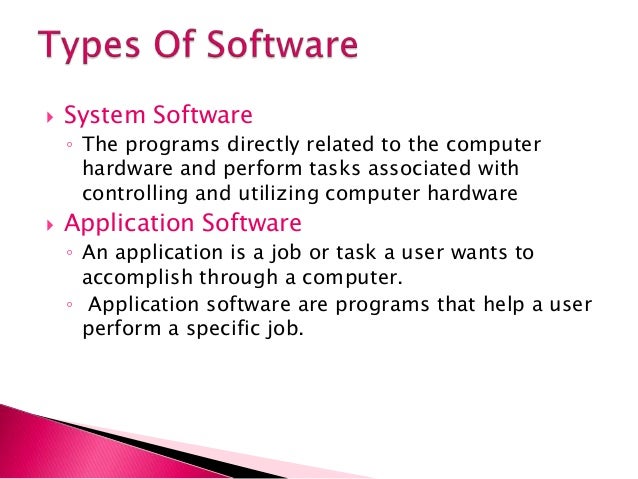
    Types of Software

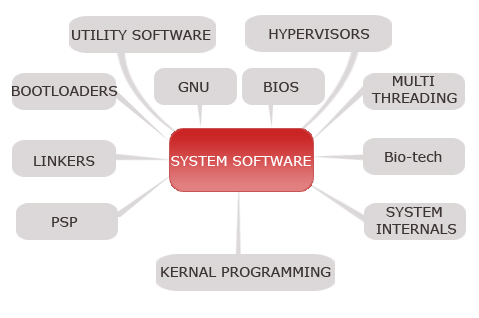
    System Software


    System Software


    System software (systems software) is computer software designed to operate and control the computer hardware and to provide a platform for running application software.System software can be separated into two different categories, operating systems and utility software.
    • The operating system (prominent examples being z/OS, Microsoft Windows, Mac OS X and Linux), allows the parts of a computer to work together by performing tasks like transferring data between memory and disks or rendering output onto a display device. It also provides a platform to run high-level system software and application software.
      • A kernel is the core part of the operating system that defines an API for applications programs (including some system software) and an interface to device drivers.
        • Device drivers such as computer BIOS and device firmware provide basic functionality to operate and control the hardware connected to or built into the computer.
      • A user interface "allows users to interact with a computer." Since the 1980s the graphical user interface (GUI) has been perhaps the most common user interface technology. The command-line interface is still a commonly used alternative.
    • Utility software helps to analyze, configure, optimize and maintain the computer, such as virus protection.
    In some publications, the term system software also includes software development tools (like a compiler, linker or debugger).
    In contrast to system software, software that allows users to do things like create text documents, play games, listen to music, or web browsers to surf the web are called application software. The line where the distinction should be drawn isn't always clear. Most operating systems bundle such software. Such software is not considered system software when it can be uninstalled without affecting the functioning of other software. 

    Tuesday, June 9, 2015

    Data (computing)

    Data (computing)


    Data treated as singular, plural, or as a mass noun) is any sequence of symbols given meaning by specific acts of interpretation.Digital data is the quantities, characters, or symbols on which operations are performed by a computer, stored and recorded on magnetic, optical, or mechanical recording media, and transmitted in the form of electrical signals. A program is a set of data that consists of a series of coded software instructions to control the operation of a computer or other machine. Physical computer memory elements consist of an address and a byte/word of data storage. Digital data are often stored in relational databases, like tables or SQL databases, and can generally be represented as abstract key/value pairs. Data can be organized in many different types of data structures, including arrays, graphs, and objects. Data structures can store data of many different types, including numbers, strings and even other data structures. Data pass in and out of computers via peripheral devices.
    In an alternate usage, binary files (which are not human-readable) are sometimes called "data" as distinguished from human-readable "text". The total amount of digital data in 2007 was estimated to be 281 billion gigabytes (= 281 exabytes).

    Software

    Software


    Computer software or simply software is any set of machine-readable instructions that directs a computer's processor to perform specific operations. Computer software contrasts with computer hardware, which is the physical component of computers. Computer hardware and software require each other and neither can be realistically used without the other. Using a musical analogy, hardware is like a musical instrument and software is like the notes played on that instrument.
    At the lowest level, executable code consists of machine language instructions specific to an individual processor – typically a central processing unit (CPU). A machine languageconsists of groups of binary values signifying processor instructions that change the state of the computer from its preceding state. For example, an instruction may change the value stored in a particular storage location inside the computer – an effect that is not directly observable to the user. An instruction may also (indirectly) cause something to appear on a display of the computer system – a state change which should be visible to the user. The processor carries out the instructions in the order they are provided, unless it is instructed to "jump" to a different instruction, or interrupted.