Showing posts with label Storage devices. Show all posts
Tuesday, June 9, 2015
Computer Components
A general purpose computer has four main components: the arithmetic logic unit (ALU), the control unit, the memory, and the input and output devices (collectively termed I/O). These parts are interconnected by buses, often made of groups of wires. Inside each of these parts are thousands to trillions of small electrical circuits which can be turned off or on by means of an electronic switch. Each circuit represents a bit (binary digit) of information so that when the circuit is on it represents a “1”, and when off it represents a “0” (in positive logic representation). The circuits are arranged in logic gates so that one or more of the circuits may control the state of one or more of the other circuits. The control unit, ALU, and registers are collectively known as a central processing unit (CPU). Early CPUs were composed of many separate components but since the mid-1970s CPUs have typically been constructed on a single integrated circuit called amicroprocessor.
Data storage devices
A data storage device is a device for recording (storing) information (data). Recording can be done using virtually any form of energy, spanning from manual muscle power in handwriting, to acoustic vibrations in phonographic recording, to electromagnetic energy modulatingmagnetic tape and optical discs.A storage device may hold information, process information, or both. A device that only holds information is a recording medium. Devices that process information (data storage equipment) may either access a separate portable (removable) recording medium or a permanent component to store and retrieve data.
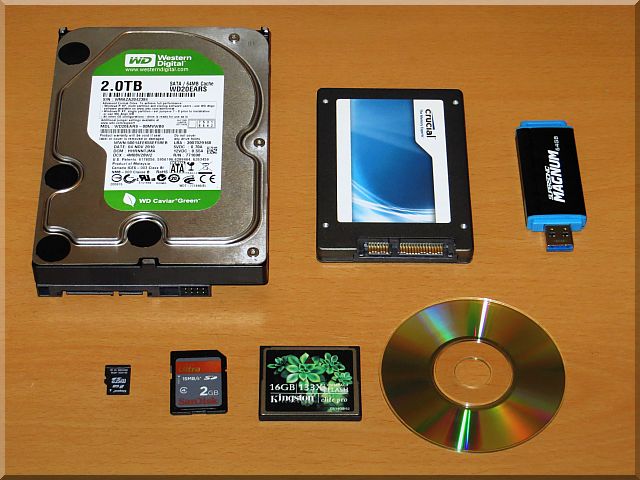
Electronic data storage requires electrical power to store and retrieve that data. Most storage devices that do not require vision and a brain to read data fall into this category. Electromagnetic data may be stored in either an analog data or digital data format on a variety of media. This type of data is considered to be electronically encoded data, whether it is electronically stored in a semiconductor device, for it is certain that a semiconductor device was used to record it on its medium. Most electronically processed data storage media (including some forms ofcomputer data storage) are considered permanent (non-volatile) storage, that is, the data will remain stored when power is removed from the device. In contrast, most electronically stored information within most types of semiconductor (computer chips) microcircuits are volatile memory, for it vanishes if power is removed.
Subscribe to:
Posts (Atom)

